HIPAA Compliance for Online Pharmacies: How Your Health Data Is Protected
Google Preferred Source
Follow Premier Dream to see verified medications, guides, and pricing in your Google Search & AI results.
Learn how HIPAA protects your online prescription records, ePHI encryption, Notice of Privacy Practices, tracking-pixel limits, and breach notifications.
Under federal U.S. law, licensed online pharmacies that transmit health claims or electronic prescription data qualify as HIPAA Covered Entities. That means your prescription history, shipping address, payment records, and clinical messages are legally protected as Electronic Protected Health Information (ePHI) under the HIPAA Privacy, Security, and Breach Notification Rules. Knowing how these rules work is a vital piece of how to buy prescription drugs online legally while keeping sensitive medical purchases confidential.
Privacy is one of the top reasons patients choose mail-order and digital pharmacies over standing at a crowded retail counter. Yet online ordering also introduces digital privacy risks—from weak checkout encryption to unauthorized third-party ad trackers. Below is a clear patient guide to how HIPAA safeguards your records and what you can verify before placing an order.
What Data Counts as Protected Health Information (ePHI)?
Protected Health Information (PHI) includes any individually identifiable information relating to your past, present, or future health condition, healthcare provision, or payment for care. When created, stored, or transmitted electronically by an online pharmacy, it becomes ePHI. Common examples include:
- Medication names, strengths, refill dates, and prescription numbers.
- Your full name, date of birth, phone number, email, or home shipping address when linked to a medication order.
- Prescriber details submitted during online pharmacy prescription verification.
- Insurance member IDs, payment receipts tied to medical items, and clinical chat logs with pharmacists.
Core HIPAA Rules Every Online Pharmacy Must Follow
The Privacy Rule & Mandatory Notice of Privacy Practices (NPP)
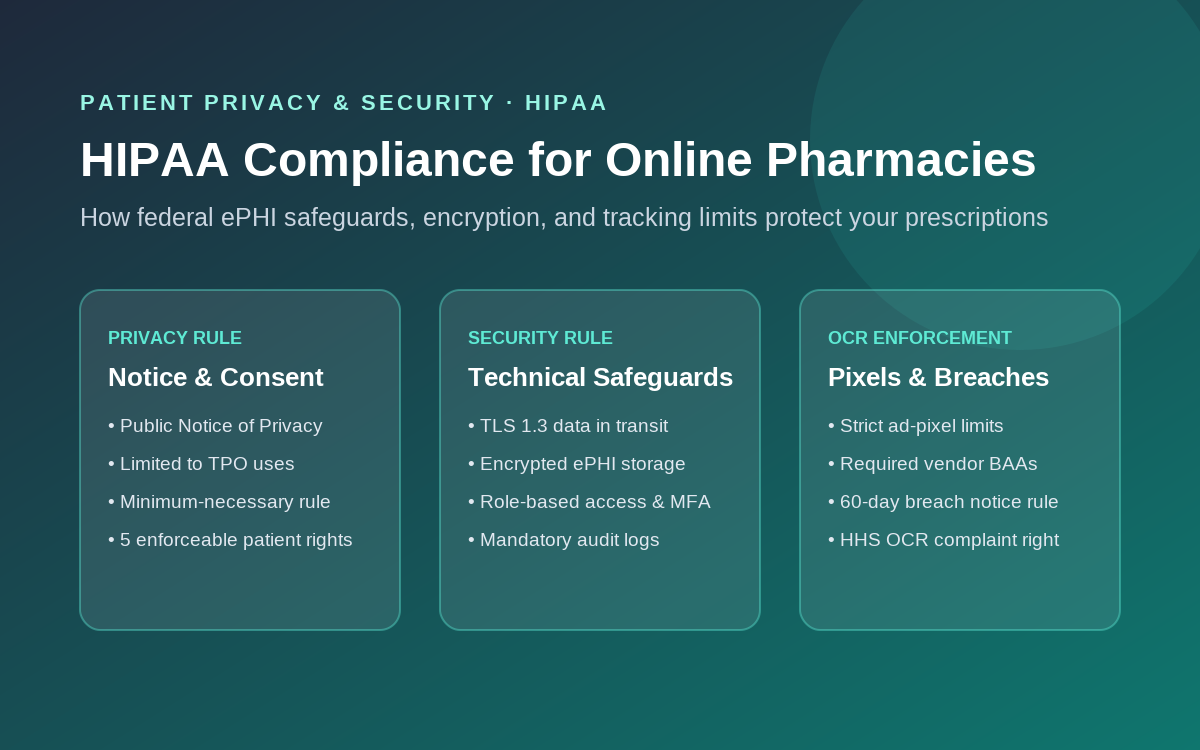
The HIPAA Privacy Rule (45 CFR Part 164, Subpart E) requires every covered pharmacy to publish a clear Notice of Privacy Practices (NPP) explaining how your medical information may be used, when written authorization is required, and how you can exercise your legal rights. Always check a site’s published online pharmacy privacy policy HIPAA disclosures before creating an account.
Permitted Uses: Treatment, Payment & Health Care Operations (TPO)
Without your separate written authorization, a HIPAA-covered pharmacy may only share ePHI for tightly defined purposes: Treatment (verifying scripts with your doctor or coordinating clinical care), Payment (billing insurance or processing checkout), and Health Care Operations (internal quality audits and regulatory compliance). Selling prescription lists to data brokers or marketing networks without explicit written authorization is strictly prohibited.
The Security Rule: Encryption, Access Controls & Audit Logs
The HIPAA Security Rule mandates three layers of protection for all ePHI systems:
| HIPAA Safeguard Layer | What the Pharmacy Must Implement | What Patients Can Verify |
|---|---|---|
| Technical Safeguards | TLS encryption in transit, encrypted database storage, unique staff logins, MFA, automatic audit logs | Valid HTTPS padlock, modern TLS certificate, secure account login |
| Administrative Safeguards | Formal risk assessments, staff HIPAA training, signed vendor Business Associate Agreements (BAAs) | Published Privacy Policy / NPP naming a privacy officer or support contact |
| Physical Safeguards | Restricted dispensing-facility access, locked paper-script archiving, secure workstation disposal | Verifiable physical pharmacy address and discreet, tamper-evident parcel packaging |
The Breach Notification Rule (Individual & HHS Reporting)
If an unauthorized party accesses unsecured ePHI, the HIPAA Breach Notification Rule requires the pharmacy to notify affected patients in writing without unreasonable delay and no later than 60 calendar days after discovering the breach, and to report the incident to the U.S. Department of Health and Human Services Office for Civil Rights (HHS OCR).
Third-Party Tracking Pixels & Analytics Restrictions
In recent guidance, the HHS Office for Civil Rights (OCR) clarified that HIPAA rules also govern online tracking technologies—such as advertising pixels, session-replay scripts, and third-party analytics cookies—on authenticated patient portals and prescription checkout flows. If a tracking pixel transmits a user’s IP address alongside pages revealing a specific prescription checkout or medical condition to an ad vendor without a signed Business Associate Agreement (BAA) or explicit HIPAA authorization, that disclosure can violate federal law.
Privacy-first pharmacies minimize third-party scripts on cart, checkout, and account pages, offer clear cookie consent controls, and avoid retargeting shoppers with medication ads across social media.
Your 5 Patient Privacy Rights Under HIPAA
- Right of Access: Request electronic or paper copies of your prescription and dispensing history (typically fulfilled within 30 days).
- Right to Request Amendments: Ask the pharmacy to correct inaccurate allergy, medication, or demographic entries in your record.
- Right to an Accounting of Disclosures: Request a log of certain non-TPO disclosures of your health information over the past six years.
- Right to Confidential Communications: Request alternative contact methods or discreet delivery instructions where feasible.
- Right to File a Complaint: Report suspected privacy violations directly to the pharmacy’s privacy officer or to HHS OCR without fear of retaliation.
How to Check an Online Pharmacy’s Privacy Safeguards Before Ordering
Run this quick 4-point privacy inspection before submitting your details:
- Check HTTPS & Checkout Isolation: Confirm the browser address bar shows an active HTTPS connection across every catalog, login, and payment step.
- Read the Privacy Policy & Cookie Notice: Look for plain-language explanations of data encryption, retention windows, and neutral billing descriptors.
- Confirm Discreet Packaging & Billing: Verify that parcels ship in unmarked exterior packaging with no drug names printed on the shipping label. Check our online pharmacy ordering FAQ for packaging and billing details.
- Review Terms & Legal Standing: Pair your privacy check with our full guide on how to buy prescription drugs online legally and our Terms & Conditions.
Dr. Sarah Lane
PharmD, Licensed Pharmacist