Online Pharmacy Legal Requirements: Federal, State & Disclosure Rules
Google Preferred Source
Follow Premier Dream to see verified medications, guides, and pricing in your Google Search & AI results.
Understand federal and state online pharmacy legal requirements, including the Ryan Haight Act, DEA registration, multi-state licensing, and mandatory website disclosures.
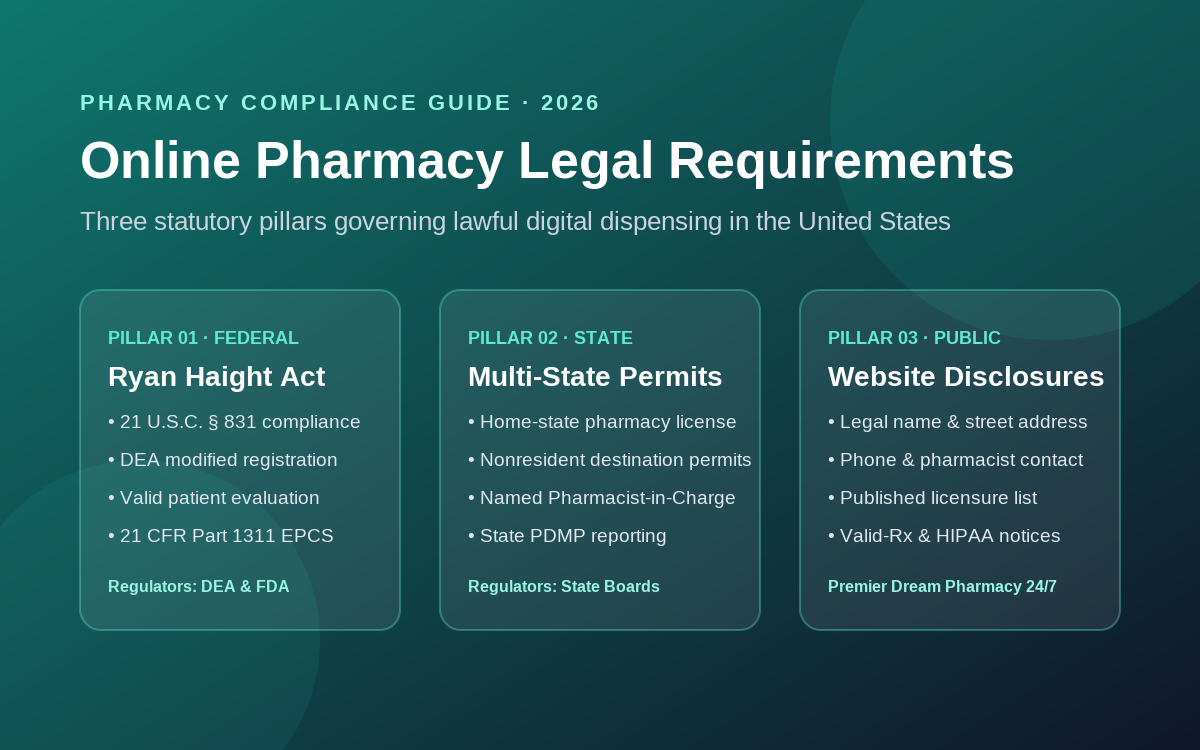
To operate lawfully in the United States, an online pharmacy must satisfy three overlapping legal pillars: active pharmacy licensure in both its home state and every destination state where it ships medications, modified Drug Enforcement Administration (DEA) registration when dispensing controlled substances, and prominent public website disclosures mandated by the Ryan Haight Online Pharmacy Consumer Protection Act (21 U.S.C. § 831). Understanding these requirements is essential before learning how to buy prescription drugs online legally and evaluating any digital dispensary.
Because prescription fulfillment crosses state lines and digital storefronts can mask who actually dispenses a medication, federal and state regulators enforce strict transparency rules. Below is a plain-English breakdown of the federal statutes, state licensing frameworks, electronic prescribing standards, and website disclosures that separate compliant pharmacies from rogue storefronts.
Federal Laws Governing Online Pharmacies
Federal oversight of internet pharmacies is split primarily between the Drug Enforcement Administration (DEA), which regulates controlled substances under the Controlled Substances Act (CSA), and the U.S. Food and Drug Administration (FDA), which oversees drug safety, labeling, supply-chain integrity, and non-controlled prescription drugs.
The Ryan Haight Online Pharmacy Consumer Protection Act (21 U.S.C. § 831)
Enacted in 2008 as an amendment to the Controlled Substances Act, the Ryan Haight Act prohibits delivering, distributing, or dispensing any controlled substance (Schedules II through V) via the internet without a valid prescription issued for a legitimate medical purpose in the usual course of professional practice. Under 21 U.S.C. § 829(e), a valid prescription generally requires at least one in-person medical evaluation unless a narrow statutory telemedicine exception or active DEA telehealth rule applies. Online questionnaires submitted without a bona fide clinician-patient relationship do not satisfy federal law.
DEA Modified Internet Pharmacy Registration (21 CFR Part 1300–1311)
A brick-and-mortar retail pharmacy cannot simply launch a website and begin shipping controlled substances nationwide under its standard DEA certificate. Under 21 CFR § 1301.19 and 21 CFR § 1304.40, any pharmacy meeting the federal definition of an “online pharmacy” must apply for a modified DEA registration authorizing online dispensing of controlled substances, notify the DEA at least 30 days before offering controlled medications online, and submit monthly dispensing reports when volume thresholds are triggered.
FDA Authority Under the Federal Food, Drug, and Cosmetic Act
Even when a medication is not a controlled substance—such as antibiotics, blood-pressure tablets, or oral diabetes therapies—it remains regulated by the FDA under the Federal Food, Drug, and Cosmetic Act (FD&C Act). Dispensing prescription-only (“legend”) drugs without a valid practitioner order renders the product misbranded under 21 U.S.C. § 353(b). Through its FDA BeSafeRx program, the agency also monitors unapproved foreign imports, counterfeit packaging, and Drug Supply Chain Security Act (DSCSA) traceability compliance.
| Regulatory Body | Primary Legal Scope | Statutory / Rule Reference | Public Verification Tool |
|---|---|---|---|
| DEA | Controlled substances (Schedules II–V), modified online pharmacy registration, EPCS | 21 U.S.C. § 831; 21 CFR Parts 1301, 1304, 1311 | DEA Registration Validation / Diversion Control |
| FDA | Drug approval, authentic supply chain (DSCSA), misbranding, foreign imports | 21 U.S.C. § 353(b) (FD&C Act) | FDA BeSafeRx & Warning Letters Database |
| State Boards of Pharmacy | Resident & nonresident pharmacy permits, Pharmacist-in-Charge, DUR rules | Individual State Pharmacy Practice Acts | State Board License Lookup & NABP safe.pharmacy |
| HHS OCR | Electronic Protected Health Information (ePHI), privacy notices, breach reporting | HIPAA Privacy, Security & Breach Rules (45 CFR Parts 160 & 164) | HHS OCR Portal |
Mandatory Website Disclosures Every Legal Pharmacy Must Publish
Under 21 U.S.C. § 831(c), every covered online pharmacy must display specific compliance information clearly and conspicuously on its homepage or via a direct link from the homepage. Patients can use this checklist to audit a pharmacy’s transparency in under two minutes:
| Required Disclosure Element | What Must Be Shown Publicly | Why It Matters for Patients |
|---|---|---|
| Official Legal Name & Street Address | Registered business name and physical dispensing street address (not a P.O. Box alone) | Allows patients to cross-check physical location against State Board records |
| Direct Telephone & Email Contact | Working phone number and contact channel reaching pharmacy staff | Enables timely questions about side effects, dosage, or order status |
| Pharmacist-in-Charge (PIC) | Full name, professional degree, and states of licensure of the responsible pharmacist | Establishes clinical accountability under state pharmacy practice law |
| Licensed Dispensing States | Complete list of every U.S. state where the pharmacy holds an active permit | Confirms lawful nonresident shipping to your delivery address |
| DEA Modification Statement | Certification of compliance with CSA modified registration (for controlled drugs) | Verifies federal authorization for Schedule II–V internet dispensing |
| Valid-Prescription Compliance Notice | Explicit statement that controlled drugs are never dispensed without a valid prescription | Distinguishes lawful dispensaries from illegal “no-Rx” storefronts |
Multi-State & Nonresident Pharmacy Licensing
Pharmacy practice in the United States is licensed at the state level, which means federal DEA registration alone never authorizes a pharmacy to ship medications across state borders.
Home-State vs. Nonresident Pharmacy Permits
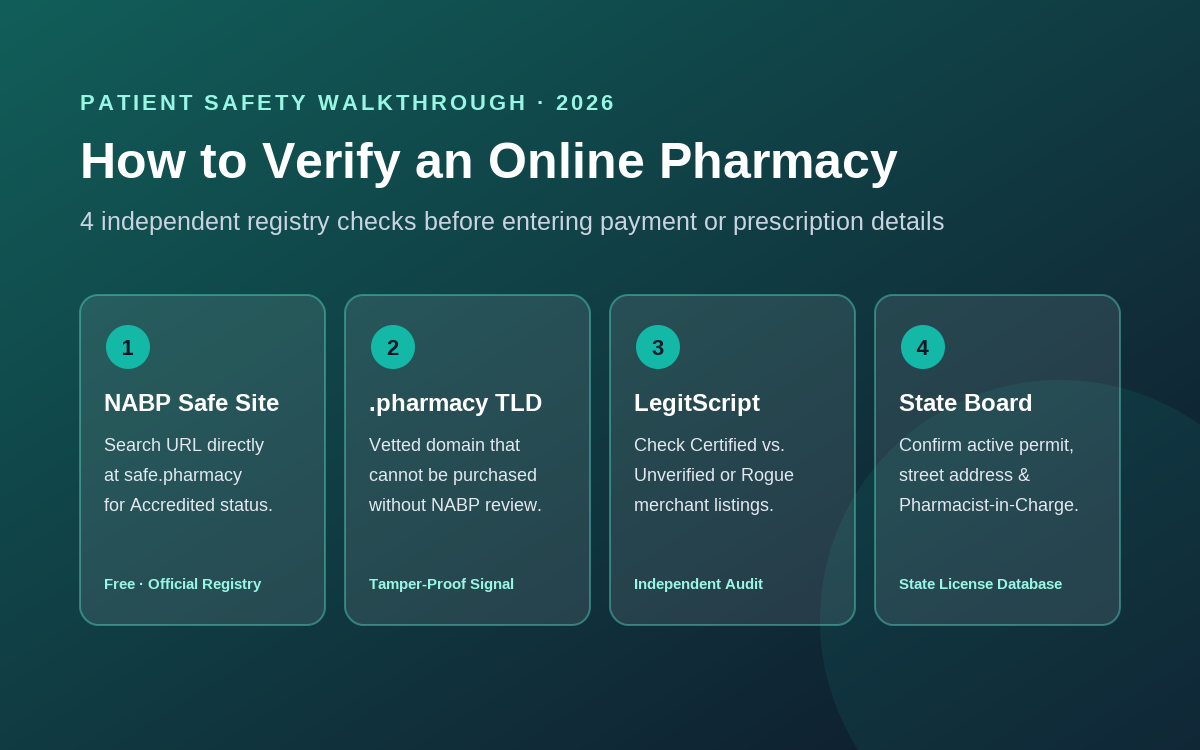
Every dispensing facility must hold an active resident pharmacy permit in the state where medications are physically stored, verified, and packaged. Before mailing prescriptions to patients in other states, the pharmacy must also secure a nonresident (mail-order) pharmacy permit from each destination State Board of Pharmacy. Some states additionally require the Pharmacist-in-Charge to hold an individual pharmacist license in the destination state and mandate periodic inspection reports (such as NABP Verified Pharmacy Program inspections). To check whether a site holds active permits for your address, follow our step-by-step walkthrough on how to verify online pharmacy credentials.
Why Valid Physician–Patient Relationships Are Mandatory
State medical boards and pharmacy practice acts require that every prescription stem from an established practitioner–patient relationship involving appropriate history review, clinical assessment, and follow-up documentation. Pharmacists hold a legal corresponding responsibility (21 CFR § 1306.04) to refuse filling any prescription that appears forged, altered, or issued outside legitimate medical standards.
Electronic Prescribing (EPCS) & Recordkeeping Compliance
Modern online pharmacies rely heavily on digital prescription transmission rather than mailed paper scripts, which triggers strict federal technical standards.
DEA 21 CFR Part 1311 Security & Archiving Standards
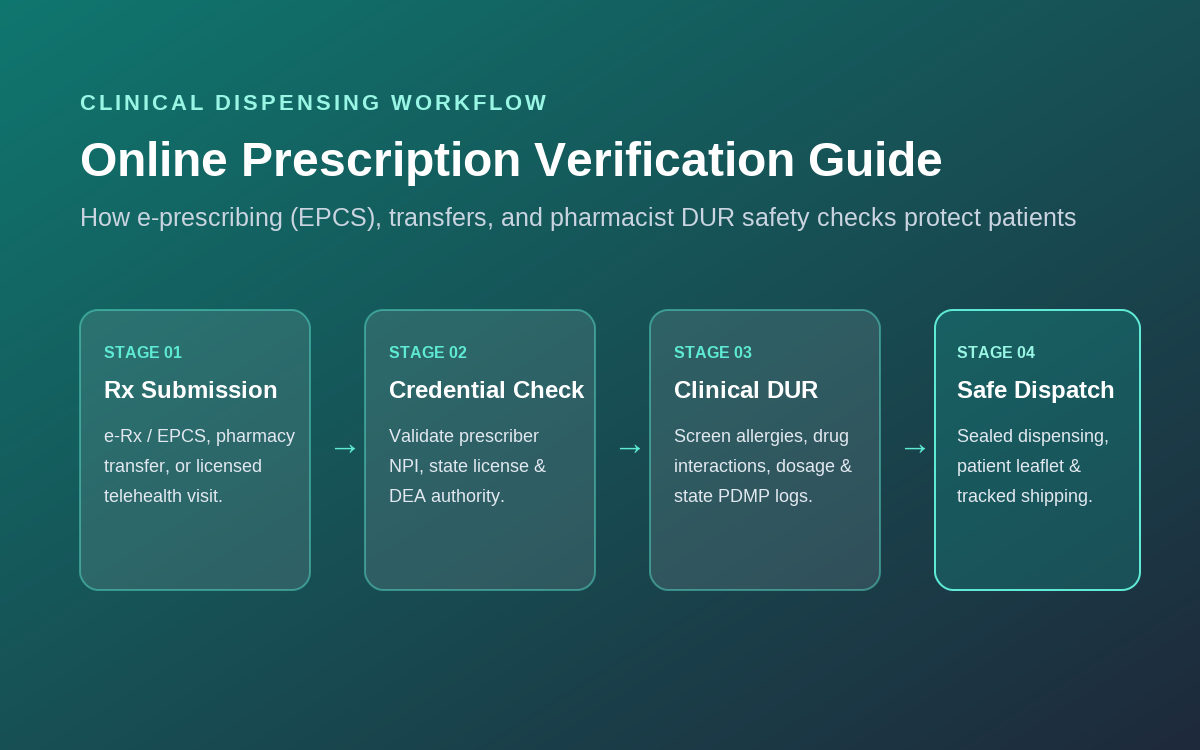
When transmitting controlled-substance prescriptions electronically, both the prescriber’s software and the receiving pharmacy’s dispensing platform must comply with Electronic Prescriptions for Controlled Substances (EPCS) rules under 21 CFR Part 1311. These regulations mandate identity proofing, two-factor authentication (2FA) for prescriber signatures, digitally signed prescription records, tamper-evident audit logs, and secure multi-year record retention.
Telehealth Prescribing Boundaries vs. Online Questionnaires
Legitimate telehealth clinics conduct synchronous video or state-permitted clinical evaluations with licensed physicians, nurse practitioners, or physician assistants who review your health history, current medications, and contraindications. By contrast, rogue websites that offer instant prescription “approvals” through a brief automated form—without clinician interaction or verification—violate both state medical practice laws and federal misbranding statutes. Always review an online pharmacy medical disclaimer to verify that the storefront does not substitute web copy for individualized medical evaluation.
How Legal Requirements Map to Terms, Disclaimers & Patient Verification
Before placing an order on any digital pharmacy platform, take two minutes to compare the site’s published policies against the rules outlined above. Legitimate sites publish accessible online pharmacy terms and conditions detailing age eligibility (18+ or age of majority), valid-prescription requirements, payment settlement, shipping timelines, refund eligibility, and governing law. They also publish a dedicated Privacy Policy explaining how prescription records and checkout data are encrypted and safeguarded.
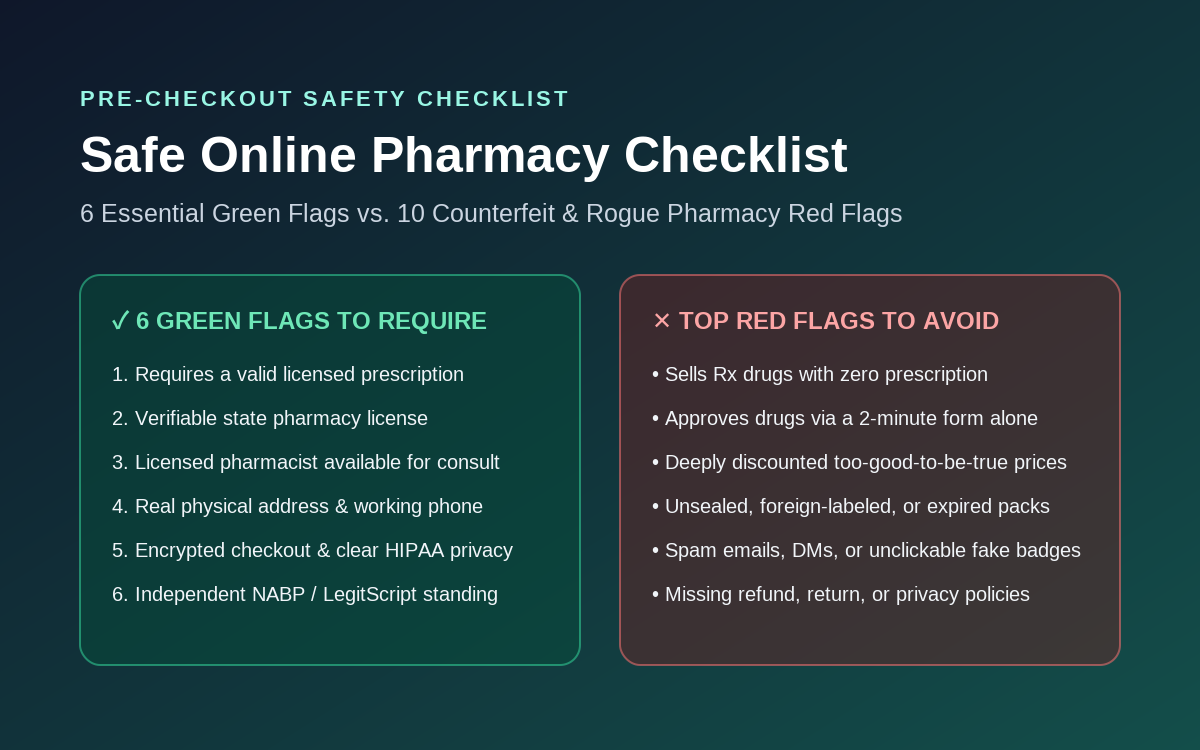
If you are evaluating multiple providers or checking a storefront for the first time, pair this legal framework with our complete pillar guide on how to buy prescription drugs online legally and our safe online pharmacy checklist.
Frequently Asked Questions
Does the Ryan Haight Act apply to non-controlled prescription drugs?
The Ryan Haight Act specifically amends the Controlled Substances Act and governs Schedule II–V controlled substances. However, non-controlled prescription medications (such as antibiotics or diabetes tablets) are still strictly regulated under the Federal Food, Drug, and Cosmetic Act and state pharmacy practice acts, which equally require a valid prescription and active state pharmacy licensure.
Can an online pharmacy legally ship to my state without a nonresident license?
In nearly all U.S. jurisdictions, no. A pharmacy must hold both an active resident license in its home state and a nonresident pharmacy permit from the destination State Board of Pharmacy before shipping prescriptions to patients living in that state.
Are international online pharmacies subject to U.S. FDA import rules?
Yes. Under the FD&C Act, importing unapproved foreign prescription drugs into the United States is generally prohibited, though FDA enforcement discretion covers narrow personal-use circumstances. Buyers ordering internationally should review local customs regulations and consult a licensed healthcare professional before purchasing.
Dr. Sarah Lane
PharmD, Licensed Pharmacist